Showing posts with label power. Show all posts

Wednesday, July 11, 2018

Feasting on power

In the end, Mark's story is about Jesus.  A good author could probably explain the reason this story about John the Baptist is so effective in unveiling Jesus' real identity, however it is good to remember that in the end, this is a story about Jesus.

And power.

Even with all his great power, Herod couldn’t silence the preacher named John who was not afraid to speak out against wrong. Herod knew that John was right, and he feared him as a holy and righteous man, but John was a problem.  First, Herod had him imprisoned.  Next, Herod served John up on a platter. In the end, Herod's own (infrequently used) conscience told him he was wrong, on all counts.  Herod's feast led to him feasting on his own evil and ego.

That is how power deals with uncomfortable or inconvenient truth.  It squashes the opposition, jails the journalists, martyrs the activists, and insists on its own (alternate) reality.  Or it grounds the teenager, turns a deaf ear to the spouse, fires the employee, labels the woman, shoots the black man.

Meanwhile, Jesus was feeding people on bread and the Word of God.  There was no power to equal the power of Jesus, the man teaching and healing in the streets and breaking bread on the hillside.  In a short time, Jesus would be on the top of another hillside feeding the world on his own body and blood.
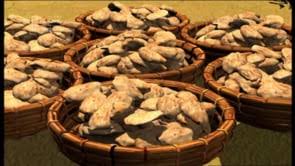
Image result for 12 baskets left overHerod was feasting on power.  Herod would never be satisfied.  

Jesus feasted on love and had twelve baskets of leftovers.   That's who Jesus is.

Mark 6.14-29

Tuesday, July 10, 2018

Fear and Power

Fear and Power.

The story told in the 6th chapter of Mark begins with the dilemma of who Jesus really and truly was. People just didn't know what to do with all the stories they had heard, and possibly even the healings and miraculous feedings they had observed. Who is this man of Nazareth called Jesus?    'Some say Elijah or one of the prophets of old,' we are told.  

But Herod was sure it was John the Baptist, raised from the dead.  And Herod was afraid.  The big guy was afraid.  So much power, so much fear.

Image result for john the baptist head on a silver platterYou see, for a man with so much power, Herod spent a great deal of energy being afraid.  He was afraid that one of his sons would gain too much power and overthrow him (so he had them killed).  He was afraid that Rome would throw him out of office.  He was afraid that John the Baptist was preaching the truth about his marriage/morality and folks would listen to him, a rebellion would break out and undermine his power. He was afraid that John the Baptist was, in fact, a prophet (for Herod recognized him as a holy and righteous man) and there might be cosmic consequences for his actions. I believe in some corner of Herod's heart (a corner he apparently assiduously ignored) Herod was afraid of God.

It all started at a lavish banquet complete with a dancing girl where Herod was afraid of looking weak in front of his rich acquaintances at his birthday feast. I imagine a large quantity of alcohol in an atmosphere of seduction led to his foolish promise, but now, Herod is haunted by that night.  'I will give you whatever you ask even to half of my kingdom" he promised.  She wanted John's head.  On a platter.

This is a young girl who will soon be married off to whomever pleases her parents.  In most situations, she is counted among the powerless.  But not that night.  That night she had Herod right where she (or probably more accurately, her mother) wanted him.  She was powerful because Herod was afraid.

Fear and Power.  Power and fear.  Did I mention they go together like hand in glove?


Mark 6.14-29

Monday, July 9, 2018

Power and fear

Seems they go together like hand in glove.  Power generates fear; fear gives space for power.

I mention this because the story of Jesus of Nazareth should never be read in a vacuum.  Jesus, like his cousin John before him, lived, worked, taught, preached in an atmosphere of fear thanks to the power of the ruling Roman Empire.  Remember always to read those sweet Sunday School Bible stories with a fully armed and underpaid Roman Soldier standing at your shoulder.

Image result for john the baptist(As an aside, consider the long list of potential sources of power:  political, economic, gender, race, military, public reputation, sexual, even, my friends, religious.  There are many empires with power over our comings and goings.)

I mention this because this week John the Baptist loses his head.  Actually it had happened in a previous episode and we are getting a flashback from Herod, but this is the point in the gospel story according to Mark that we actually learn about it.

Some will say that John lost his head even before that terrible moment in the castle dungeon.  He insisted on calling Herod out on his ill-advised marriage to his brother's (I assume she is now his ex) wife.  Herod prided himself on his Jewish connections and the Torah is clear about this particular situation; you can not marry your brother's wife.  Simple as that.

John kept pointing this out.  Publicly. Embarrassing?  Annoying for sure.  Particularly since Herod recognized John as a holy and righteous man, and thought a conversation with John might do him some good.  So he arrested him which accomplished two things:  no more public pronouncements about Herod's morality and Herod could always find John for a quiet conversation any time of day or night

When you think about it, it's a pretty strange situation.  On the face of it, John had no power over Herod at all and yet Herod hesitated to silence John because he feared ......what?  Public backlash? His own conscience?  God?

This powerful and brutal man hesitated because of a still, small voice?

Hmmm.  Power and fear lead us to do curious things.


Mark 6.14-29

Tuesday, January 8, 2013

What's the Spirit got to do with it?

If the Spirit is actively guiding your life, perhaps you shouldn't mention it.....at least not around staid, stoic Lutherans.

Lutherans have historically had a limited relationship with the Holy Spirit.   Well, that's not completely true.  We recognize and acknowledge the work of the Spirit as recorded in the scriptures.  We just don't talk about the Spirit's power or movement in our day to day lives, or in our worship, or in our prayer.  I think we don't really know what to do or say about the Spirit, so we don't say anything.

The Holy Spirit is the power of God moving and acting in this world (and possibly in other worlds as well but that's not the point).  Jesus was raised from the dead by the power of the Holy Spirit - ergo the Spirit gives life, even new life.  Elijah was directed to return to his calling as a prophet (out there in the cave, you know, the 'still small voice') so the Spirit can direct our work and our days.  The Spirit moved among the worshippers on the day of Pentecost and everyone spoke boldly, openly and everyone else understood them.....so the Spirit gives us boldness to speak and openness to hear.

The Spirit is more that a 'feeling' but I expect most of us first experience the Spirit's moving through an inner sense that we would call a feeling.  Sometimes the Spirit guides us by giving us clarity - about a decision to be made or a person who needs to be visited.  Sometimes the Spirit calls us into a situation quite unbeknownest to us so we can witness the Spirit at work and be inspired to new work on God's behalf.

In our baptism, we are anointed with the Holy Spirit.  At confirmation, our young people once again call on the Spirit to guide their feet and build their faith.  At ordination, the Spirit is invoked (we call on its name) to bless and guide the new pastor. 

Perhaps we are afraid of the Spirit's power?  I don't know; being raised from the dead is a pretty exciting possibility.  How about we increase our quotient of Spirit talk and expectation?  What could that bring in 2013?

Thursday, January 3, 2013

If Momma ain't happy

If Momma ain't happy, ain't nobody happy.
 
Do you know this old saying? I think it is always good to remember.  Some folks' unhappiness has a way of being spread around.

So it was with Herod - King Herod - in Jerusalem.  Herod came from a line of rulers who were known for their ruthlessness.  Making Herod unhappy (any of the Herods) was dangerous business.

So what were the Wise Men thinking?  This faux pas alone raises a question as to how wise they really were.  They stepped right into Herod's palace and inquired about the birth of the King of the Jews.  No wonder  "When King Herod heard this, he was frightened and all Jerusalem with him"  Matthew 2.3

I expect that King Herod thought there was a new king in the making - one who would grow in power until he competed with Herod, power to power, winner take all.  The fact that this newborn was to be King of the Jews only shifted Herod's concern from the rise of a Roman competitor to a possible leader of a revolution....and, might I paraphrase, When Herod wasn't happy, no one was happy.  Lots of young boys paid the price for Herod's fear, a fear that would grip another Herod 30 years later when confronted with the grown Jesus. 

In the end, both Herods were sure they had won this confrontation with an erstwhile 'King'.  Neither understood the kind of power Jesus held - the power of love which knows no bounds, which is willing to lay down its life for the sake of the other.

Herod might have had control of the palace.  Jesus reigns eternally from a greater throne.  Herod had good reason to be nervous; his time was indeed running out.

Thursday, October 11, 2012

"Seek good and not evil, that you may live"

This is Amos' advice to the people of the Northern Kingdom (sometimes referred to in the prophets as the house of Joseph, sometimes referred to as Israel).

This is what it has come down to:  seek good and not evil, so you may live.  Because there will be nothing else left after God's judgment prevails.  Amos 5.6-7, 10-15

Amos is one of only two prophets whose primary focus is economic justice.  He speaks of the economic oppression of the poor by their own people.  He speaks of the lack of justice at the city gate, both for those with disputes but also for the needy who sought help.   (Note:  a judge or wise elder would sit at the city gate and any party who had a dispute would take their case to the judge and he would make a ruling.  Amos claims the judges were bribed to rule in favor of the wealthy.)

In other words, the system was rigged.  That is what 'justice' is about in the Bible; establishing an even playing field for all where political or economic power is a tool to be used for the betterment of those in need and to advance the common good.  Not every one ends up 'rich' in a just system; but everyone has equal access and is the concern of every other citizen.

You may have noticed that we are in the heat of the political system.  We have heard claims, counter claims, truths, half truths and outright lies.  The thoughtful among us know that no matter what the candidate says, s/he must contend with the system once in office, and the unforeseen events that shift our choices.

And yet we must decide.  We need to listen closely.  Who will benefit from the position this politician is taking?  Who will lose out?  Am I concerned only with what will happen to me or have I considered the common good?  Are they telling some version of the truth about what is possible to achieve? 

This applies to both domestic and foreign policy.  Most of this is way beyond my pay grade; I don't really understand the intricacies of economic policy nor the complex situations that exist in Libya or the Middle East.  I work to think through, to listen closely to whether what is proposed will, in any way, increase the common good.  Is it just?  To all?

This text from Amos comes at a good time for us.  To quote Jesus, "Let those who have ears, listen."

Monday, July 23, 2012

Sex and the Sinner

I have chosen the alternate Old Testament text for Sunday:  2 Samuel 11.1-15, the story of David and Bathsheba.

For those who aren't familiar with this lurid tale (one of several equally lurid tales in the Old Testament), King David catches a glimpse of his neighbor's wife bathing in the courtyard of her house, sends for her, lays with her, causes her to get pregnant, and eventually has her husband killed in order to hide his infamy.

See?  You don't have to buy the National Enquirer to get this stuff.  It's right here, and it's a story about the most honored of Israel's kings.  In fact, YHWH promises that an offspring of David will always sit on the throne.  [You can see where the title Son of David is important when applied to Jesus.]  Throughout the Bible, we watch God using flawed, sinful individuals to bring about God's will.

In this story, we have the perfect storm of lust and power; not unusal then nor is it unusual now.  Wrong then; wrong now.  It is ironic, however, that this lesson coincides with the announcement of the NCAA penalties against Penn State and the removal of the Joe Paterno statue from the front of the college stadium. 

There are many ways to talk about this story.  Here is the first.  Sin lies deep within the heart of every single one of us (and some of us, it is not so deeply seated).  Power / prestige often functions as the accelerator to sinful behavior.  I am speculating when I say that King David was so full of himself he had little space to consider the other.  He chose to respond to the announcement of an imminent birth of a child with the order for the imminent death of the husband. 

Never found yourself in that position?  Really?  Never thought you were in the right and you had the power to make the other person agree with you?  Your child?  Your spouse?  At work?  At the check-out?  Desire and power, a volatile combination.