Showing posts with label empire. Show all posts

Wednesday, July 11, 2018

Feasting on power

In the end, Mark's story is about Jesus.  A good author could probably explain the reason this story about John the Baptist is so effective in unveiling Jesus' real identity, however it is good to remember that in the end, this is a story about Jesus.

And power.

Even with all his great power, Herod couldn’t silence the preacher named John who was not afraid to speak out against wrong. Herod knew that John was right, and he feared him as a holy and righteous man, but John was a problem.  First, Herod had him imprisoned.  Next, Herod served John up on a platter. In the end, Herod's own (infrequently used) conscience told him he was wrong, on all counts.  Herod's feast led to him feasting on his own evil and ego.

That is how power deals with uncomfortable or inconvenient truth.  It squashes the opposition, jails the journalists, martyrs the activists, and insists on its own (alternate) reality.  Or it grounds the teenager, turns a deaf ear to the spouse, fires the employee, labels the woman, shoots the black man.

Meanwhile, Jesus was feeding people on bread and the Word of God.  There was no power to equal the power of Jesus, the man teaching and healing in the streets and breaking bread on the hillside.  In a short time, Jesus would be on the top of another hillside feeding the world on his own body and blood.
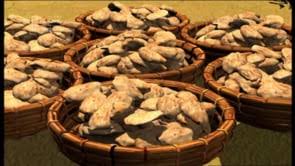
Image result for 12 baskets left overHerod was feasting on power.  Herod would never be satisfied.  

Jesus feasted on love and had twelve baskets of leftovers.   That's who Jesus is.

Mark 6.14-29

Tuesday, July 10, 2018

Fear and Power

Fear and Power.

The story told in the 6th chapter of Mark begins with the dilemma of who Jesus really and truly was. People just didn't know what to do with all the stories they had heard, and possibly even the healings and miraculous feedings they had observed. Who is this man of Nazareth called Jesus?    'Some say Elijah or one of the prophets of old,' we are told.  

But Herod was sure it was John the Baptist, raised from the dead.  And Herod was afraid.  The big guy was afraid.  So much power, so much fear.

Image result for john the baptist head on a silver platterYou see, for a man with so much power, Herod spent a great deal of energy being afraid.  He was afraid that one of his sons would gain too much power and overthrow him (so he had them killed).  He was afraid that Rome would throw him out of office.  He was afraid that John the Baptist was preaching the truth about his marriage/morality and folks would listen to him, a rebellion would break out and undermine his power. He was afraid that John the Baptist was, in fact, a prophet (for Herod recognized him as a holy and righteous man) and there might be cosmic consequences for his actions. I believe in some corner of Herod's heart (a corner he apparently assiduously ignored) Herod was afraid of God.

It all started at a lavish banquet complete with a dancing girl where Herod was afraid of looking weak in front of his rich acquaintances at his birthday feast. I imagine a large quantity of alcohol in an atmosphere of seduction led to his foolish promise, but now, Herod is haunted by that night.  'I will give you whatever you ask even to half of my kingdom" he promised.  She wanted John's head.  On a platter.

This is a young girl who will soon be married off to whomever pleases her parents.  In most situations, she is counted among the powerless.  But not that night.  That night she had Herod right where she (or probably more accurately, her mother) wanted him.  She was powerful because Herod was afraid.

Fear and Power.  Power and fear.  Did I mention they go together like hand in glove?


Mark 6.14-29

Monday, July 9, 2018

Power and fear

Seems they go together like hand in glove.  Power generates fear; fear gives space for power.

I mention this because the story of Jesus of Nazareth should never be read in a vacuum.  Jesus, like his cousin John before him, lived, worked, taught, preached in an atmosphere of fear thanks to the power of the ruling Roman Empire.  Remember always to read those sweet Sunday School Bible stories with a fully armed and underpaid Roman Soldier standing at your shoulder.

Image result for john the baptist(As an aside, consider the long list of potential sources of power:  political, economic, gender, race, military, public reputation, sexual, even, my friends, religious.  There are many empires with power over our comings and goings.)

I mention this because this week John the Baptist loses his head.  Actually it had happened in a previous episode and we are getting a flashback from Herod, but this is the point in the gospel story according to Mark that we actually learn about it.

Some will say that John lost his head even before that terrible moment in the castle dungeon.  He insisted on calling Herod out on his ill-advised marriage to his brother's (I assume she is now his ex) wife.  Herod prided himself on his Jewish connections and the Torah is clear about this particular situation; you can not marry your brother's wife.  Simple as that.

John kept pointing this out.  Publicly. Embarrassing?  Annoying for sure.  Particularly since Herod recognized John as a holy and righteous man, and thought a conversation with John might do him some good.  So he arrested him which accomplished two things:  no more public pronouncements about Herod's morality and Herod could always find John for a quiet conversation any time of day or night

When you think about it, it's a pretty strange situation.  On the face of it, John had no power over Herod at all and yet Herod hesitated to silence John because he feared ......what?  Public backlash? His own conscience?  God?

This powerful and brutal man hesitated because of a still, small voice?

Hmmm.  Power and fear lead us to do curious things.


Mark 6.14-29