Showing posts with label feeding the 5000. Show all posts

Wednesday, July 11, 2018

Feasting on power

In the end, Mark's story is about Jesus.  A good author could probably explain the reason this story about John the Baptist is so effective in unveiling Jesus' real identity, however it is good to remember that in the end, this is a story about Jesus.

And power.

Even with all his great power, Herod couldn’t silence the preacher named John who was not afraid to speak out against wrong. Herod knew that John was right, and he feared him as a holy and righteous man, but John was a problem.  First, Herod had him imprisoned.  Next, Herod served John up on a platter. In the end, Herod's own (infrequently used) conscience told him he was wrong, on all counts.  Herod's feast led to him feasting on his own evil and ego.

That is how power deals with uncomfortable or inconvenient truth.  It squashes the opposition, jails the journalists, martyrs the activists, and insists on its own (alternate) reality.  Or it grounds the teenager, turns a deaf ear to the spouse, fires the employee, labels the woman, shoots the black man.

Meanwhile, Jesus was feeding people on bread and the Word of God.  There was no power to equal the power of Jesus, the man teaching and healing in the streets and breaking bread on the hillside.  In a short time, Jesus would be on the top of another hillside feeding the world on his own body and blood.
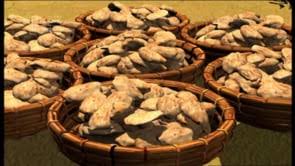
Image result for 12 baskets left overHerod was feasting on power.  Herod would never be satisfied.  

Jesus feasted on love and had twelve baskets of leftovers.   That's who Jesus is.

Mark 6.14-29

Wednesday, February 22, 2017

5000 and counting

It's one of the stories that folk remember from the Bible:  how 5 loaves and 2 fish were sufficient to feed 5000 men plus women and children.....with leftovers....12 baskets of leftovers.

Image result for 5 loaves and 2 fishIt is the perfect story to parallel our celebration of our Lord's Supper.  Jesus performs the 4 fold action:  he took the (fish) offering, blessed it, broke it, and then gave it to the disciples to distribute.  So they did, and everyone ate and was satisfied and there were leftovers.....12 baskets of leftovers. In the hands of God,  a little can become a lot.

If that is the only lesson you see or hear in this story, it is sufficient.  You can spend a lifetime living out that one line: in the hands of God, a little can become a lot.  You can apply it to your relationships, your parenting, your giving, your spiritual health.  Put it in the hands of God and wait and watch to see what God is going to do.

But for a moment let's parse that a little deeper.  First, there were a lot of people who had followed Jesus to receive a healing, a blessing, a little comfort.  There was no need to look far and wide for people in need: there were 5000 of them right in front of Jesus.  Regular people.  Ordinary people.  Hurting people.

Jesus paused in this story because of their need.  He stopped to minister to them because he was filled with compassion: a word which means 'to suffer with'.  That is, Jesus was moved to suffer with the suffering people he saw.  A touch of healing, a word of comfort, a new found hope were the blessings he bestowed.  And I am sure folks were grateful, but after a couple of hours, they were also growing hungry.

Now Jesus turns towards the disciples who are worried about the hungry crowd (and the lack of any good concession stands in the neighborhood).  Jesus says: 'You feed them.'  'With what?' they ask.  'We only have 5 loaves and 2 fish.'

At this point, what could be simply a miraculous feeding event turns into an object lesson for the disciples:  What do you have to do the Lord's work?  How much of it are you willing to give to meet these needs?  Are you willing to 'suffer with' these suffering people?

Someone gave up their supper.  5 loaves and 2 fish.  In the end, they saw God at work, they became workers in God's kingdom, and they were equipped (12 baskets of leftovers/one for each disciple) for tomorrow's work as well.  This is what disciples do; this is how disciples are formed.

Lots of questions to ponder.  What are you offering up to God so that God's work can be accomplished?  What resources has God put in your hands for the work that needs to be done?  Who are the suffering people right in front of you?

If it were you, would you have given all 5 loaves and both fish?  Not such a simple story at all.

Wednesday, June 25, 2014

The miracle of feeding

"There's a hunger beyond food that's expressed in food, and that's why feeding is always a kind of miracle.  It speaks to a bigger desire.  The feeding of the five thousand....the miracle wasn't that Jesus multiplied the loaves.  It's that the disciples took the bread and did what they were told, got up and started feeding, and something happened." *

What is that bigger desire that is addressed in bread and fish?  Could it be a desire to be connected to one another?  Could it be the recognition of our shared humanity in the sharing of food?  Does the passing of the bread invite us to open up to one another, to give the other a second glance?

In Paul's first letter to the church at Corinth he writes, "For all who eat and drink without discerning the body, eat and drink judgment against themselves."  (11.29)  Many denominations have used this passage to insist on examining all who step up to the Lord's table, and therefore, refusing the bread and wine to any who are unable to pass the examination.  What is this bread?  The body of Christ.  What is this wine?  The blood of Christ.

I believe Paul was speaking of an entirely different body.  I believe Paul is speaking about the body of Christ formed by the sharing of the meal; the body of Christ which is formed by those who gather at this time and in this place to become once again a part of the great mystery of God's love for us in Jesus.

Paul warns us not to step up to the Lord's table while rejecting another who the Lord has invited.  When you look across the table to those who are gathered for the meal, you need to be able to see the body of Christ and every single person gathered there as a part of that body.  You don't get to choose who is worthy and who is not.  If you cannot look with love on all the others, then step back and save yourself.  Come back when you are ready to open yourself to those whom God loved before time and who through the sacrifice of our Lord Jesus are offered new life.

But is the communion table the only table of the Lord?  Are not all our tables filled with the bounty that comes from God's hand?  Are we ever to step up to a table and not see Christ's body poured out for all humankind?  Are we to take of any bread while judging others unworthy?

Those canned peas you brought to the food drive.....they too are the body and blood of Jesus, a love poured out for all whom God created.  Are you able to see it now?  The body of Christ, formed and re-formed again and again in diner and dining room and rescue mission.  The body of Christ feeding our deepest, biggest desires.


*thanks once again to Sara Miles for her book "take this bread".  The quote comes from page 175.