Showing posts with label neighbor. Show all posts

Sunday, June 24, 2018

Love....the only commandment

Love God.  Love your neighbor. 


Some version of this lies at the heart of most religious systems.  Love involves empathy, sacrifice, and concern; all of this is wrapped up in being able to see the unbreakable connection between each of us and each of those we call 'other'.  Love involves relationship.

In 1923, Martin Buber, a German philosopher wrote a book called Ich und Du, usually translated I and Thou.  Buber's main proposition is that we may address existence in two ways:  first, in the attitude of the "I" towards and "It", that is, towards an object that is separate in itself, which we either use or experience.  The second approach is in the attitude of the "I" towards "Thou", a relationship in which the other is not separated by discrete bounds, where you and I are connected in some manner.

Image result for carrying peopleOne of the major themes of the book is that human life finds its meaningfulness in relationships.  In Buber's view, all of our relationships bring us ultimately into relationship with God, who is the Eternal Thou.  A person sitting next to a complete stranger on a park bench may enter into an "I-Thou" relationship with the stranger merely by beginning to think positively about people in general, and thus recognizing the stranger as a person as well.  (thanks to Wikipedia for this succinct summary).

You might not understand what Buber is proposing, but let me put it this way.  We are supposed to love people (thou) and use money (it).  We are prone to love money (thou) and use people (it).

Buber offers us one way to talk about how we get this 'love' thing wrong.  We might think that loving the neighbor requires warm, fuzzy feelings which we often cannot conjure up.  In the end, it doesn't; it requires we sustain relationship with the neighbor.  This is what makes loving your neighbor infinitely ore diffiult than loving God because our neighbors are so very human. They are smelly, nasty, hurtful or in a thousand other ways less than ideal companions. In Sonnet 116,  Shakespeare writes "Love is not love which alters when it alteration finds....".  Buber would say that love isn't love when our commitment is to our own comfort and not to the relationship between us.  Love cannot make an object of the other, make it into an 'it', a tool to be used whether for pleasure or gain or safety.  Love requires relationship.
  
Love looks beyond the surface in the neighbor and sees the flawed, scarred, struggling humanity we all share.  Such are the demands of love, that we see worth in every face.  Ergo, loving the neighbor is a tall order on any day of the week.  It's easy to see that loving a God who doesn’t party loudly until 2 am is a lot easier than loving your neighbor who does. 
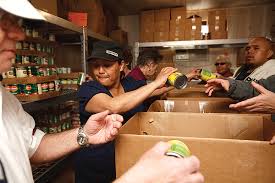
Image result for feeding peopleYet, it all begins with the neighbor, for how can you love a God you cannot see when you do not love the neighbor you can?  First feed the hungry child and then talk about your love for the Divine Creator.  Love for the Divine Creator is manifest in love for those whom the Divine Creator created.  First, connect with the lost and lonely in person before you talk about connecting with the Divine God who is both mystery and spirit.  

In the end, the commands:  Love God.  Love your neighbor.  are at the heart of our faith only when they are at the heart of our lives.


Monday, June 27, 2016

Love God, love your neighbor

The two great commandments: Love God, love your neighbor.  The lawyer who was questioning Jesus accurately stated the teaching of Torah, the law of the people of Israel.  Any child could have given the same answer.  The devil was in the details.  What does love of God look like?  How am I to love my neighbor?  How much?  How often?  To what degree?

Image result for good samaritanAnd, in the end, Who counts as my neighbor?

That was what the lawyer wanted to know.  Define who my neighbor is and I will then go about 'loving' that person and thus fulfill my obligation to God.  [parable of the Good Samaritan Luke 10]

Now, I am glad he was concerned about being in right relationship with God.  I don't think it is either fair or accurate to assume he was attempting to minimize the challenge of his commitment to following God nor to assign nefarious intent in his request for precision.  Not that there weren't darker intentions lurking behind all the questions:  we all have darker intentions, we all are looking for a way to ease our conscience, we all sin.  So let's not beat up on the lawyer.  He wanted to get it right.

But of course, you can't get the neighbor thing right if you don't get the 'love' part right, and love can be a slippery thing.  Love is a very deep well.  It is both cotton candy (very sweet, floating all over the place and sticking to everything) and as strong as steel.  Usually there are shared values, regard for the other's welfare, and a commitment to each other that defies outside forces.  It's about trust, respect and sacrifice.  Love is that which remains when all that is ephemeral disappears.  It is the hot core at the center of it all.

So, I think that we have a major problem before we even get to the neighbor question.  The demands of love are enormous and, truthfully, we don't act with love continually.  Sometimes the sacrifice that love demands is far greater than we are able or willing to give.  Yet, even as we cry out "I just can't!" we turn again and seek to 'love' again, giving it one more try.  Humans are inconsistent lovers.

Given the difficulty of love (whether it be God or neighbor) we move on to the difficulty of 'neighbor.'  Somehow we can convince ourselves that we 'love' God - deeply, consistently, with honesty.  This is easier because we don't run into God when we go to the market or pump our gas.  We don't have to talk to God before we have our morning coffee or at the water cooler at work (that isn't true, but that's a discussion for another day.)  Neighbors, however, are a much different subject.  We might love neighbors in the abstract, but people in the flesh are much harder to take.  With or without our morning coffee.

I understand the lawyer's desire to figure out who he is obligated to love as his neighbor.  Otherwise this whole 'love' thing could get out of hand; he needs some boundaries.  Who then is my neighbor?
It's one of those questions that if you have to ask, you don't understand what you are talking about.

And of course he doesn't understand what he is asking because we all live in a quid pro quo world and Jesus is talking about God's coming kingdom.  We live in a world where looking out for yourself, your family and then your friends is our primary focus and often more than we can handle.  We seek our advantage because, frankly, no one else will.  We separate some folks because we have about as much as we can handle here. The demands of providing are killing us now; we cannot be asked to provide for every other human being we encounter.

And he is right, of course.  We can't feed all the hungry or clothe all the teenagers or hire all the unemployed or find housing for all the homeless.  We can't do it all.  All of this 'loving' is killing us; there have to be limits.

Or maybe, it is all this 'not loving' that is killing us.  Maybe if there was a little more love in our relationships that man wouldn't have ended up in the ditch.  Perhaps he is left as good as dead because 'loving our neighbor' isn't a guiding principle for everyone.  We get another reminder of this as two - two! - apparently religious men see his plight and avoid responsibility by passing by on the other side - as far away from this 'neighbor' as they can get.

So now we are ready to hear how Jesus thinks about this, how God looks at this, and how God's heart responds to this Child of God lying in the mud by the road.

Be prepared for some sacrifice here.


Love God, love your neighbor

The two great commandments: Love God, love your neighbor.  The lawyer who was questioning Jesus accurately stated the teaching of Torah, the law of the people of Israel.  Any child could have given the same answer.  The devil was in the details.  What does love of God look like?  How am I to love my neighbor?  How much?  How often?  To what degree?

And, in the end, Who counts as my neighbor?

That was what the lawyer wanted to know.  Define who my neighbor is and I will then go about 'loving' that person and thus fulfill my obligation to God.  [parable of the Good Samaritan Luke 10]

Now, I am glad he was concerned about being in right relationship with God.  I don't think it is either fair or accurate to assume he was attempting to minimize the challenge of his commitment to following God nor to assign nefarious intent in his request for precision.  Not that there weren't darker intentions lurking behind all the questions:  we all have darker intentions, we all are looking for a way to ease our conscience, we all sin.  So let's not beat up on the lawyer.  He wanted to get it right.

But of course, you can't get the neighbor thing right if you don't get the 'love' part right, and love can be a slippery thing.  Love is a very deep well.  It is both cotton candy (very sweet, floating all over the place and sticking to everything) and as strong as steel.  Usually there are shared values, regard for the other's welfare, and a commitment to each other that defies outside forces.  It's about trust, respect and sacrifice.  Love is that which remains when all that is ephemeral disappears.  It is the hot core at the center of it all.

So, I think that we have a major problem before we even get to the neighbor question.  The demands of love are enormous and, truthfully, we don't act with love continually.  Sometimes the sacrifice that love demands is far greater than we are able or willing to give.  Yet, even as we cry out "I just can't!" we turn again and seek to 'love' again, giving it one more try.  Humans are inconsistent lovers.

Given the difficulty of love (whether it be God or neighbor) we move on to the difficulty of 'neighbor.'  Somehow we can convince ourselves that we 'love' God - deeply, consistently, with honesty.  This is easier because we don't run into God when we go to the market or pump our gas.  We don't have to talk to God before we have our morning coffee or at the water cooler at work (that isn't true, but that's a discussion for another day.)  Neighbors, however, are a much different subject.  We might love neighbors in the abstract, but people in the flesh are much harder to take.  With or without our morning coffee.

Image result for good samaritanI understand the lawyer's desire to figure out who he is obligated to love as his neighbor.  Otherwise this whole 'love' thing could get out of hand; he needs some boundaries.  Who then is my neighbor?
It's one of those questions that if you have to ask, you don't understand what you are talking about.

And of course he doesn't understand what he is asking because we all live in a quid pro quo world and Jesus is talking about God's coming kingdom.  We live in a world where looking out for yourself, your family and then your friends is our primary focus and often more than we can handle.  We seek our advantage because, frankly, no one else will.  We separate some folks because we have about as much as we can handle here. The demands of providing are killing us now; we cannot be asked to provide for every other human being we encounter.

And he is right, of course.  We can't feed all the hungry or clothe all the teenagers or hire all the unemployed or find housing for all the homeless.  We can't do it all.  All of this 'loving' is killing us; there have to be limits.

Or maybe, it is all this 'not loving' that is killing us.  Maybe if there was a little more love in our relationships that man wouldn't have ended up in the ditch.  Perhaps he is left as good as dead because 'loving our neighbor' isn't a guiding principle for everyone.  We get another reminder of this as two - two! - apparently religious men see his plight and avoid responsibility by passing by on the other side - as far away from this 'neighbor' as they can get.

So now we are ready to hear how Jesus thinks about this, how God looks at this, and how God's heart responds to this Child of God lying in the mud by the road.

Be prepared for some sacrifice here.


Thursday, January 2, 2014

Forgiveness is so old school

Whatever the newer generations are looking for it isn't forgiveness.  I  keep hearing words like meaning or purpose or connection.  Folks want to make a diffference, participate, contribute to the greater good.

So here is a plan.  Blanket your life and the world around you with an act which says, "Yup, I know how things can get out of hand."  Look at your neighbor and see yourself: behaving badly, at the end of your rope, exhausted and worried sick.  Remember that day when you were sure the entire world was against you or the one when you were against the entire world.

Make space for other human beings to be human beings.  Give each other some room to breathe.

It will give meaning and purpose to your life; your connections with your neighbors will increase and you will make a difference in this world, contribute to the greater good.

Call it anything you want, but be sure not to skimp. Forgive.  Not once. Not twice, but each time you encounter something that needs forgiving. For at the heart of our lives, it is forgiveness we crave the most.


Tuesday, September 24, 2013

The Grand Canyon of Life

In this week's parable Jesus talks about 'a great chasm.'  One of my colleagues pictured it as the Grand Canyon.  The people on one side can't get to the other.  Really quite a poetic image, but the reality of living on the wrong side of a great chasm I couldn't cross is much less so.

Jesus builds up this image of the chasm between a rich man and Lazarus.  The rich man is clothed in purple (very expensive!) cloth and fine linen .....and Lazarus is clothed in 'sores that the dogs lick.'  The rich man lives in a mansion with a gate to keep out the unwanted ones; Lazarus lives outside the gate. He is one of the unwanted ones.  The rich man has sumptuous feasts every day; Lazarus would have been satisfied with the crumbs from the rich man's table.  Luke 16

Now that's a chasm.  This rich man is very, very, very rich and Lazarus is equally poor.  Jesus doesn't want to leave any doubts in the hearer's minds.  He describes a chasm of wealth which leads to a chasm between God and the rich man.

What do we do with this old story?  First, we don't try to convince ourselves that the same conditions are unheard of today.  Great chasms exist today and wealth is often the underlying source.  Second, we are to see how the rich man's blindness to his neighbor (because, in fact, Lazarus lived right outside his gate) built a great chasm between him and God.  The rich guy saw Lazarus only as someone put there to serve his needs....not as another human being with needs (overwhelming needs!) of his own.

Most importantly, the rich man was blind to God's purpose for this world from the beginning, but especially in the life and ministry of Jesus.  Jesus came to mend this world - to heal it - to make it whole - to bring it again into perfect relationship with God the Creator.  Anything which keeps us from being a part of this great healing of the world also keeps us from God.

N.T. Wright, a biblical scholar has written "What you do in the present- by painting, preaching, singing, sewing praying, teaching, building hospitals, diggings wells, campaigning for justice, writing poems, caring for the needy, loving your neighbor as yourself - will last into God's future."  Or as one blogger writes, 'Whatever we do to mend the world has lasting value.  Everyone contributes.  God blesses each and every gift.'

Great wealth can lead to great blindness and a mistaken trust in the protection that wealth provides.  But it is not only wealth that can pull us away from contributing to God's vision of a redeemed world.....it is just that most of the time it does.  Money too often makes us blind.

The rich man had so much with which he could have balanced the scales of justice for Lazarus, and possibly for many others as well.  He wouldn't have reversed the spin of the earth but he would have contributed the blessings he had received to God's holy plan through his care for one neighbor.  One neighbor.  One.


Monday, September 9, 2013

Give me Jesus

It's an old African American spiritual.  Give me Jesus. You can have all the rest, give me Jesus.

You'll never ask for Jesus unless you have some need for forgiveness and grace in your life.

You'll never ask for Jesus if you are convinced that, by your own effort, all good things will come to you.

You'll never ask for Jesus if you stand so deeply in the darkness that you cannot breathe.

Those who truly know the power of a living God of forgiveness and grace in your life, who have walked in the darkness and now see light, who are thankful that someone else is in charge of the big picture of life.....we are called to carry the truth of Jesus to those who do not know.  When our neighbor asks for Jesus, we are to show up and walk with them.

Love God.  Love your neighbor.  That's our calling.