Showing posts with label Bible interpretation. Show all posts

Sunday, April 15, 2018

Opened the scriptures

Seems I have been trying to get folks to open the scriptures my whole life.  When I was young, I wanted the adults to open the scriptures by reading the story deeply and asking it the thousands of questions that come to mind.  What do angels look like?  Can you hear their voice or do the words just sort of appear in your mind?  Did God ask someone to be the mother of Jesus before asking Mary?  How do we explain Jesus healing people from miles away? and so forth, and so forth.  You can imagine rightly that I drove both my confirmation pastor and countless hapless adults who were trying to teach crazy. They confused my curiosity with impertinence.

Image result for road to emmaus
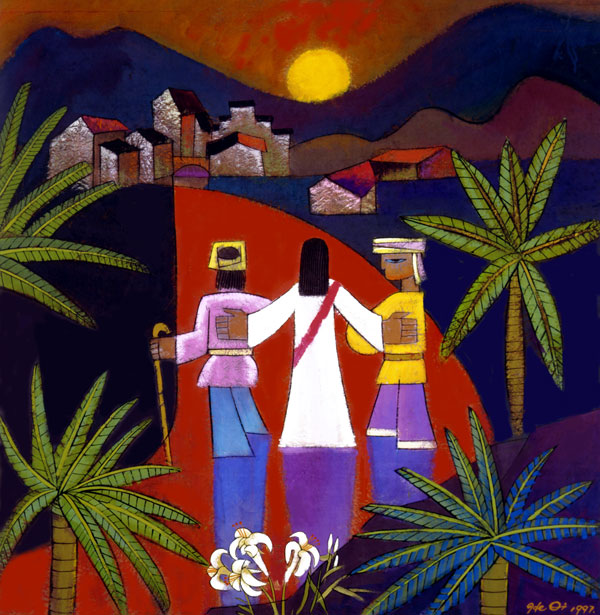
Road to Emmaus by artist  He Qi
There was little improvement when I began studying with other adults.  Seems most of the adults simply wanted to be told what it meant.  Interpret it for me; just lay out the lesson for me.  My questions just seemed to confuse the issue.  (How could they confuse the issue when we sure what the issue was?).  I was not really welcome at a lot of places.

Then I went to 'deacon school' where I met a New Testament scholar by the name of the Rev. Dr. Richard Carlson, and boy could he teach the scriptures.  There wasn't a question too outrageous for him.  Speculation was one of his tools for engaging the stories of the Bible.  What if?  What could this mean?  What do we know about doctors or women or merchants or Roman soldiers from that time?  What does this tell us?  I fell in love.....not with him, but with the scriptures.

I always knew there was something more.  I always knew that these stories were complex and most of the time I was just skimming the surface.  God talks to us through these stories and it takes very close listening to discover God's revelations.  A story as dense and complex as the story of God working in and through humankind and all of creation requires wrestling, not skimming.  There are many voices and lessons to be heard.

In the gospel of Luke we are given two post-resurrection stories of Jesus appearing to disciples and in both it says that 'Jesus opened the scriptures' for them.  "Were not our hearts burning within us when he opened the scriptures to us?" they ask.  This leads me to wonder....

,,,,,God's Word and fire are often associated in the Bible. Think about Moses and the burning bush, Jeremiah and the fire in his belly, and now these disciples.   I wonder why fire?

....Jesus 'opened' the scriptures for them.  Was this just a deeper explanation.......or was it the revelation of Jesus as the interpretive (hermeneutical) key to the whole God story? What were they learning about God that was new or surprising?

....That burning sensation....Was it heartburn (like I often get when I need to really concentrate on some complex problem of logic) or was it that 'burn' that comes when, although you are working hard, you know you are accomplishing much?

....What would it take to 'open the scriptures' for us today?  What am I missing?  What treasure lies just below the surface, ready for the ones who are willing to dig a little?

Very little gives me more pleasure than doing this work with fellow explorers, to read and question and speculate and listen to God speaking through others as they wrestle with God's word.  As we huddle over a story and listen to one another, we hear God speaking through multiple filters.  In the end, I have often heard God speak in new and exciting ways.  The scriptures are opened once again.

You can do this.  Find yourself some companions for this adventure.  Stick with it.  Be prepared to encounter God in new ways.

But please, open the scriptures and take the time to read and listen.  God has so much to say.


Monday, March 20, 2017

Reformation Monday: Sola Scriptura

I find it amusing that Lutherans are known for their 'alone' theology:  Word alone. Faith alone, Grace alone.  We who do 'both and' theology also have 3 distinct 'alones' to guide our way.

Image result for Luther and bibleSo let's look at Sola Scriptura:  Word Alone.  As simple as the phrase is, it is a complex concept.  Luther was NOT saying that anybody reading the plain words of the Bible could clearly ascertain the message of the Bible from its plain meaning.  [Just like 'we'll have to do lunch sometime' means you can expect an invitation this week.]


#1 Lutherans do not interpret the Bible literally. Luther and Lutherans of the ELCA kind are not literal interpreters of the Bible.  So in the story where Balaam's donkey speaks, we do not think that there truly was a talking ass.  Certainly there is a message in that story, but not that donkeys had a day once when they spoke in comprehensible language.

#2 Not every ancient manuscript which claimed to be speaking God's Word was considered authentic or authoritative. Not everything was included in the official canon (the agreed upon list of writings to be included in the Bible) because church leaders felt they distorted the God story. .  For years in the early church, the list of recognized writings to be included shifted a little back and forth until the canon was closed in the early 400's.  These other writings are called 'extra-textual' by the scholars and can provide some insight into early practice and the evolution of creeds.  One such is The Didache which you can read here Didache text

#3 Lutherans understand the Bible to be the inspired Word of God.  Inspired = Spirit led, but transmitted to us through human agents.  God may be eternal but humans are rooted in time and space.  We are shaped by the culture in which we live, the part of the world where we are born, even our social class and gender.  A simple example of this might be:  a fireman would tell stories in terms of emergencies and fast response and putting out fires.  A 1st century woman would tell her stories from the perspective of birthing and raising children, cooking and sewing.  They are trying to tell us something about this God that they know and who has been revealed to them, but they use the images and experiences that are a part of their lives.

This means that the Bible is tied to particular historic times and cultures and practices.  These practices shape the way in which the God story is told because that is the only way the folks writing it all down know how to tell the story.  The 16 year old girls of Jesus' time were not discussing which college they wanted to attend.  They were about to be married (if not already) and have children.  That's what 16 year old girls did.

So as we read the Bible together and listen for God's voice and God's revelation, we also need to know the context in which the story was written.  A good study Bible will include an introduction to each of the books and helpful notes at the bottom of the pages to help you figure some of this out.  There are lots of books published by Augsburg Fortress to help you figure it out.

This figuring out process is best done in a community: a group discussion where lots of questions are raised and multiple points of view expressed.....because God continues to speak to us today, sending the Spirit to guide our study and open new insights.  It is easy to see that an eternal God who speaks through an unchanging script from an ancient time can have multiple interpretations - and all those readings are skewed by our own time and place.

Ahhhhh!  I will never understand the Bible!  Not true, but it is a journey that requires time, patience and attentiveness to what is said, what is not said, who speaks, who is silent, and......my own prejudices that I bring into the mix.

The good news is, it's just loads of fun to explore and consider and break open in new ways.  Even with a bit of higher education on the subject, I am continually fed by the new and insightful readings of my study partners.

All of that, and guess what?  We haven't really gotten to Sola Scriptura yet.  But there were a few basics we needed first.  Watch this space for more Reformation Monday posts on reading the Bible.